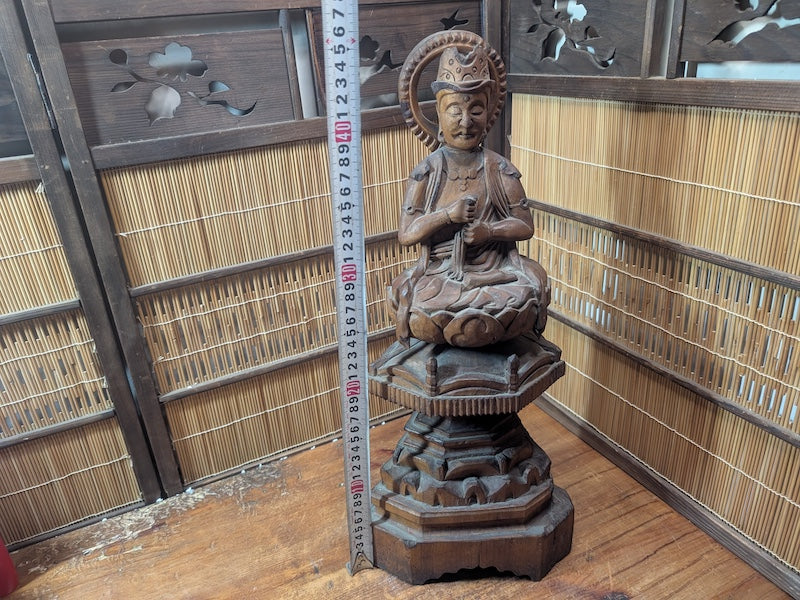
1800s Japanese Wooden Buddha Statue Edo Meiji Era Artist Signed Japan
1800s Japanese Wooden Buddha Statue Edo Meiji Era Artist Signed Japan
🪷 Extremely Rare Even in Japan Edo–Meiji Era Wooden Buddha Statue (1800s)
This exceptional antique is an authentic hand-carved wooden Buddha statue, created in Japan during the Edo–Meiji period (1800s). Seated serenely on a lotus pedestal, this Buddha exudes both spiritual presence and artistic mastery.
What makes this piece especially significant is the artist’s signature carved on the back, marking it as a genuine, one-of-a-kind work. Signed statues from this era are extremely rare and highly valued by collectors, temples, and scholars of Japanese art.
The statue’s craftsmanship reflects the tradition of Buddhist carving from the late Edo into the Meiji period, a time when Japan underwent deep cultural transformations while still preserving its sacred artistic practices.
This piece was sourced directly from a Japanese Government Antique Auction, ensuring authenticity and provenance. It is a remarkable survivor of history and a spiritual treasure.
✅ Authentic 1800s Edo–Meiji era wooden Buddha statue
✅ Artist signed on the back – extremely rare
✅ Exquisite hand-carving and serene expression
✅ Original lotus pedestal with stepped base
✅ Direct from Japanese Government Auction
✅ Perfect for collectors, museums, or spiritual display
✅ Size & Condition
Era: Edo–Meiji period (1800s)
Material: Hand-carved wood
Condition: Very good for its age, with expected natural wear and patina. Please review all photos.
Japanese (as carved)
大分縣直入郡挾村
奉納主 佐藤今朝實
意僊刻
English Translation
Ōita Prefecture, Naoiri District, Hasamura (大分縣直入郡挾村)
Dedicated by Satō Keshajitsu (奉納主 佐藤今朝實)
Carved by Isen (意僊刻 – “刻” means “carved by”)
Meaning
This inscription tells us:
The statue was dedicated in Hasamura, Naoiri District, Ōita Prefecture (Kyushu, Japan).
The donor/patron who offered the statue was a man named Satō Keshajitsu (今朝實).
The sculptor/carver signed his work as Isen (意僊).
This is very significant — most Buddhist statues from the 1800s do not name both the patron and the artist, making this an important piece with strong provenance.
📢 Important Shipping Policy Update
To ensure safe delivery, we currently ship one item per order only.
Orders with multiple items may be canceled and refunded. Once your item arrives safely, you’re welcome to place another order.
📦 Condition
Please review all photos carefully, as they form part of the item description. Dimensions and additional details are provided in the images.
Couldn't load pickup availability
Low stock: 1 left
View full details